
The technology we use
Neurofeedback
Neurofeedback enables an athlete to train quality and length of focus by means of feedback provided by quantitative EEG in real time. During the concentration excercise, match video analysis or audio stimuli the athlete receives direct feedback on the quality of his focus. The goal of the training is reinforcement of specific brain activities that are in charge of focus quality (SMR and beta waves) as well as inhibition of those activities responsible for loss of concentration (theta and delta waves).

Example: during a match video analysis the athlete is prohibited from playing the video for as long as desired focus is established (high SMR and Beta activities; low Theta activity). The video will not resume until the athlete learns how to establish and keep the optimal focus. By doing this, as well as numerous other excercises, the athlete trains his brain activity, learns to notice loss of concentration, and with psychological techniques learns how to maintain a zone of optimal performance.
NEURO-FEEDBACK TESTING
In order to individualize and adapt the training to each athlete by testing, we get feedback on focus quality.
Figure 1 shows the dominant brain activity during:
- Closed eyes
- Open eyes
- Four different concentration exercises.
Pay attention to the 3rd row and 1st column. The blue histograms indicate the alpha waves that are responsible for relaxing the mind. They are dominant considering the athlete has his eyes closed, but upon opening his eyes (3rd row, 2nd column) they should drop significantly, while the orange histograms (beta waves) in charge of focus should increase. This is not by chance when testing an athlete whose alpha waves (blue histograms) are further present upon opening his eyes and during concentration exercises, which indicates that it concerns an athlete with an over relaxed focus who does not establish the desired arousal and quickness of mind at focus exercise where quick decision making is trained. Such an athlete trains beta/theta training in which, when performing exercises, he strengthens the beta activity in charge of focus whereby he inhibits theta activity, which has a negative influence on focus quality.
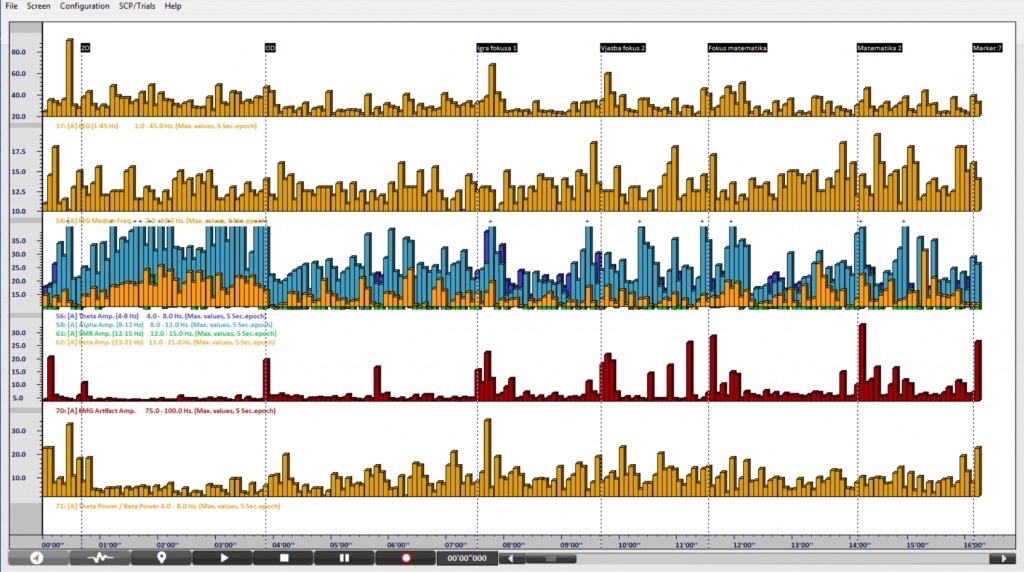
Figure 1: neuro-feedback test screen
(click to enlarge)
EMG BIOFEEDBACK
Anger in sports can be a top motivator if we know how to manage it. If we do not notice it at an early stage, it can overcome us and have an adverse effect on our performance.
Figure 2 – through EMG biofeedback training, an athlete succeeds in noticing the beginning of his anger by becoming aware of the fact that the left side of his trapezius (blue histogram) first activated when he was angry while the right trapezius, interestingly, was not activated even though he was predominantly right-handed. This athlete succeeded in realizing the beginning of his anger by becoming aware of the fact that when angry the left side of his trapezius activated (blue histogram) while the right trapezius, interestingly, was not activated even though he was predominantly right-handed.
By using retrained relaxation techniques, the athlete was able to raise awareness and relax the trapezius in a brief period, not allowing anger to have a negative effect on his performance.
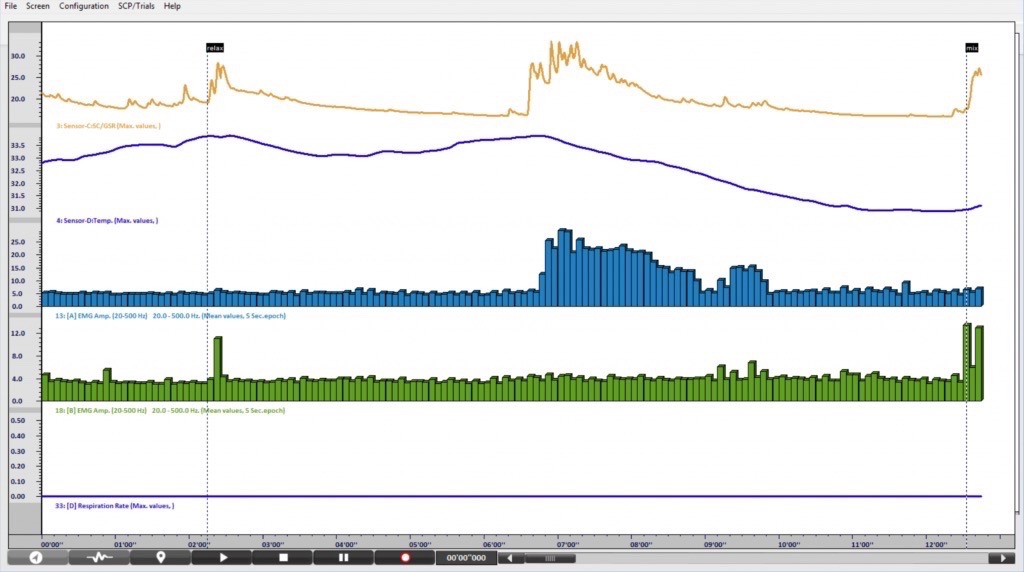
Figure 2: EMG biofeedback test screen
(click to enlarge)
SC TRAINING – PRE-COMPETITION ANXIETY
Figure 3 – through technique of visualisation, the athlete imagines his preparation for a game of great importance with closed eyes. Skin conductivity (gold line) and body temperature (red line) are then measured.
Skin conductivity (SC) indicates a high arousal of the organism, or, in this case, pre-competitive anxiety due to the importance of the match that precedes. At times when the conductivity of the skin (golden line) increases sharply, the biofeedback device gives audio feedback that indicates that the athlete’s body arousal is too high and that a practiced relaxation technique has to be applied. The athlete succeeded in that, which can be seen by the sudden drop of the gold line, while the red line (skin temperature) increased sharply.
After being in a state of optimal arousal, the athlete reimagined his upcoming game, but this time the arousal of the body was insignificantly lower than earlier and he managed to reduce his precompetitive anxiety in relatively short time.
Micro-changes in the skin, which the feedback service measures accurately, mean that the athlete has successfully managed his physiology, that is, he has become more effectively aware of the connection between his mind and his physiology.
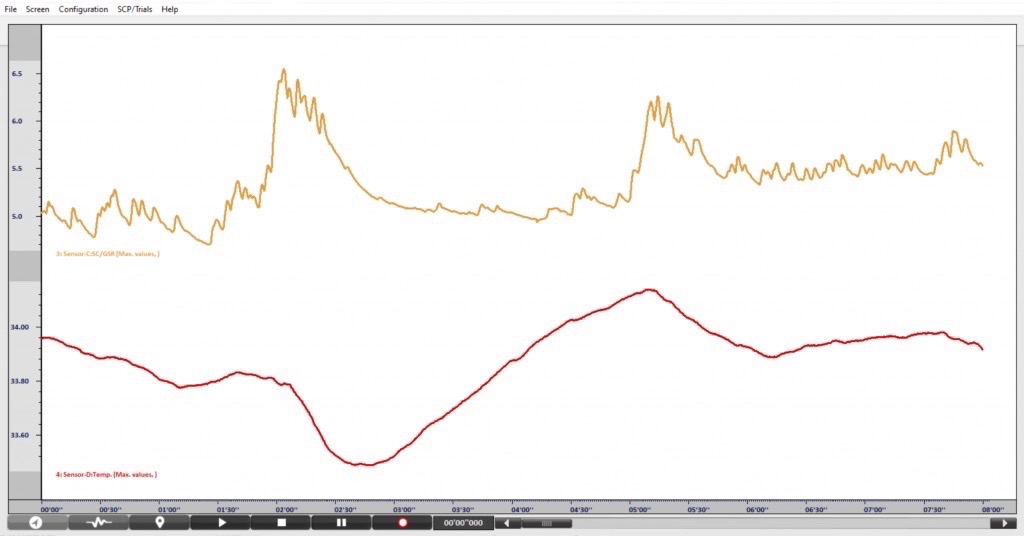
Figure 3: SC training screen
(click to enlarge)
HRV (HEART RATE VARIABILITY) TRAINING
Imagine that your body has a “brake” that you can train, monitor the percentage of activation from training to training and learn how to bring yourself into the optimal performance zone. These words can describe a small part of the benefits of HRV (heart rate variability) training. HRV is a specific way of measuring the heart rate that measures changes in the interval or distance between two heartbeats related to the physical, mental and emotional function of the body. The athlete goes through his own so-called “resonance frequency” or the number of inhalations and exhalations harmonized with the heart rhythm that most activate the vagus nerve, the parasympathetic nerve that controls the heartbeat patterns responsible for bringing the body to an optimal state of functioning.
Figure 4 – In the upper right corner of the image, the harmonization of the heart rhythm (red waves) with abdominal breathing (blue waves) is visible. The example of a trained athlete following 8 minutes of HRV training statistically showed that the athlete activated the vagus nerve (%LF) to 95% and breathed on average 5 and a half times a minute using the abdominal technique. These values are feedback prior to the competition whereby the athlete knows which ratio of inhales and exhales is more effective for his mental preparation and entry into the optimal performance zone.

Figure 4: HRV training screen
(click to enlarge)
ARRANGE A FREE INFO MEETING + 2 TRIAL TRAININGS
Take advantage of a free info meeting of 45 min and ask whatever interests you. We offer 2 trials live or online trainings where an athlete can try and experience our program.